Technical article
Large work, fewer transfers: the Hwacheon VT-1650 is coming to Douna
A new step for large, heavy turning work. With the forthcoming Hwacheon VT-1650, Douna aims to bring turning, milling and drilling closer together — with fewer transfers between machines.
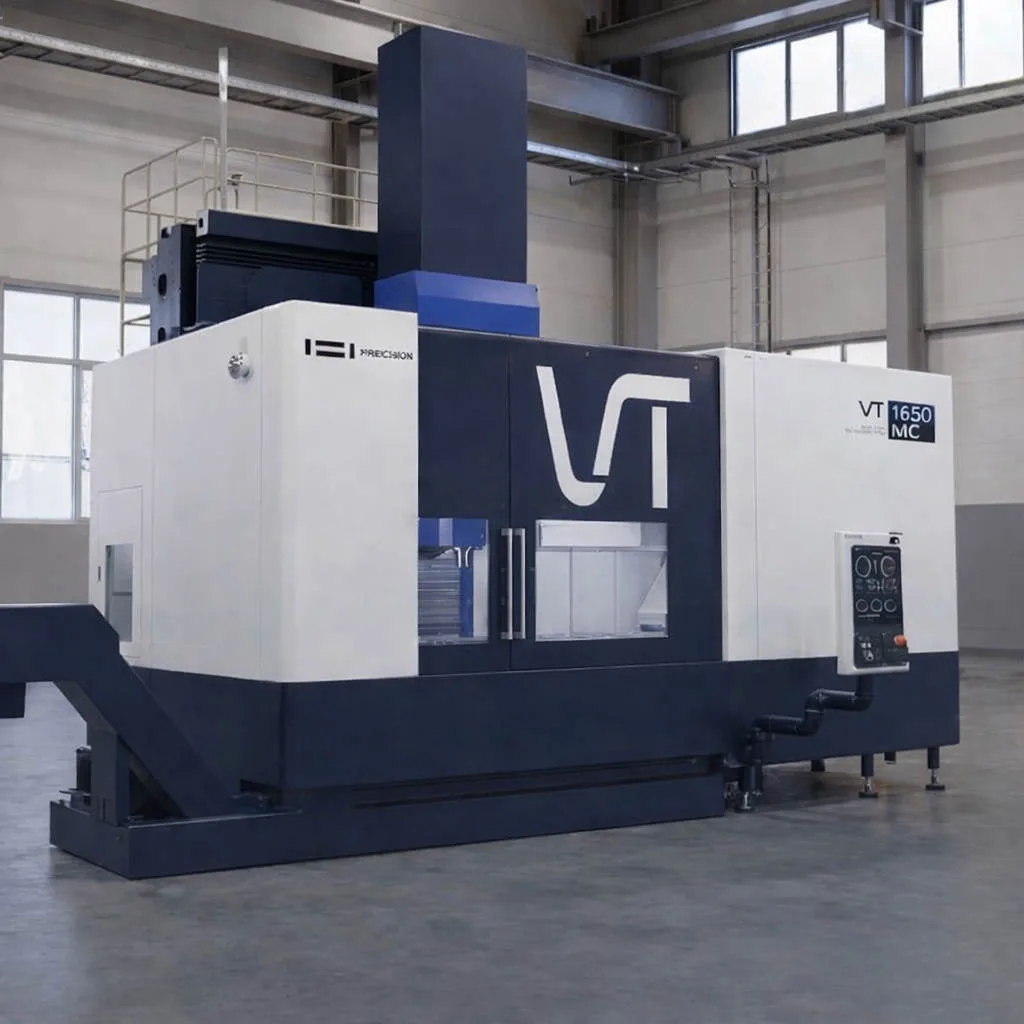
Turning a large ring is one thing. But what if that same ring also needs a bolt pattern, an accurate mating face and milled details? That is when the route between operations becomes interesting. With the planned arrival of the Hwacheon VT-1650, Douna will add a turn-mill centre designed for that combination.
Direct answer
The value lies in the combination
The Hwacheon VT-1650 is a vertical turn-mill centre. It has driven tools and a C-axis, allowing turning operations, holes and milled details to be combined in the same machine. Depending on the workpiece, this may avoid transferring it to another machine.
For Douna, this is the interesting addition: not just room for large work, but more scope to prepare different operations as one coherent route.
Large components require more than space
The VT-1650 accommodates a maximum workpiece weight of 10,000 kg. This indicates the type of work it is designed for. Think of large rings, flanges, discs and housings: components for which clamping, lifting and repositioning are also part of the technical assessment.
In vertical turning, the workpiece rests on a horizontal table. The table rotates the component past the tool. Whether a particular product fits depends on more than weight: diameter, height, centre of gravity, workholding and required tool clearance also matter.
From turned ring to fully machined component
Suppose a ring has a turned outer surface and bore, but also a bolt pattern and a local milled feature. One possible approach is to machine the turning surfaces first, then position the table using the C-axis for the drilling and milling work.
If accessibility and workholding allow, the component remains on the same machine. This may save an extra transfer and realignment. That is a valuable possibility, particularly for heavy work. The drawing and machining strategy determine which features can be made in one setup.
There is room for the tooling too
The VT-1650 has a RAM with 1,000 mm travel, a BT-50/BBT-50 tool interface and a 24-position magazine. The driven tools have a maximum speed of 3,000 revolutions per minute. This is the tool speed, not the rotary table speed.
The machine also has 30 bar through-spindle coolant, a tool presetter and two angle milling heads. Those heads have their own limits: the 3,000 revolutions per minute therefore do not apply to every accessory. Tools and holders remain selected to suit the material, feature and accessibility.
A small indexing step is not a product tolerance
The C-axis has an indexing step of 0.001°. This describes the small angular steps in which the table can be positioned. It differs from guaranteed positioning accuracy or a tolerance on the finished product.
Final dimensions also depend on workholding, tooling, thermal conditions and the measurement strategy. Precision therefore begins with a well-prepared production route and suitable inspection, rather than a single figure in a machine brochure.
An addition to look forward to
The arrival of the VT-1650 fits Douna’s approach to manufacturing: starting with the finished product and the steps needed to achieve it. A machine that combines several operations offers more scope to organise that route logically for suitable workpieces.
The VT-1650 will soon be added to the machine fleet. Commissioning is planned from the fourth quarter of 2026. Following installation and commissioning, it can be used for suitable orders.
Do you have a large component that needs turning and additional operations? With a drawing or model, material, weight, critical features and required quantities, Douna can already help consider a suitable approach.