
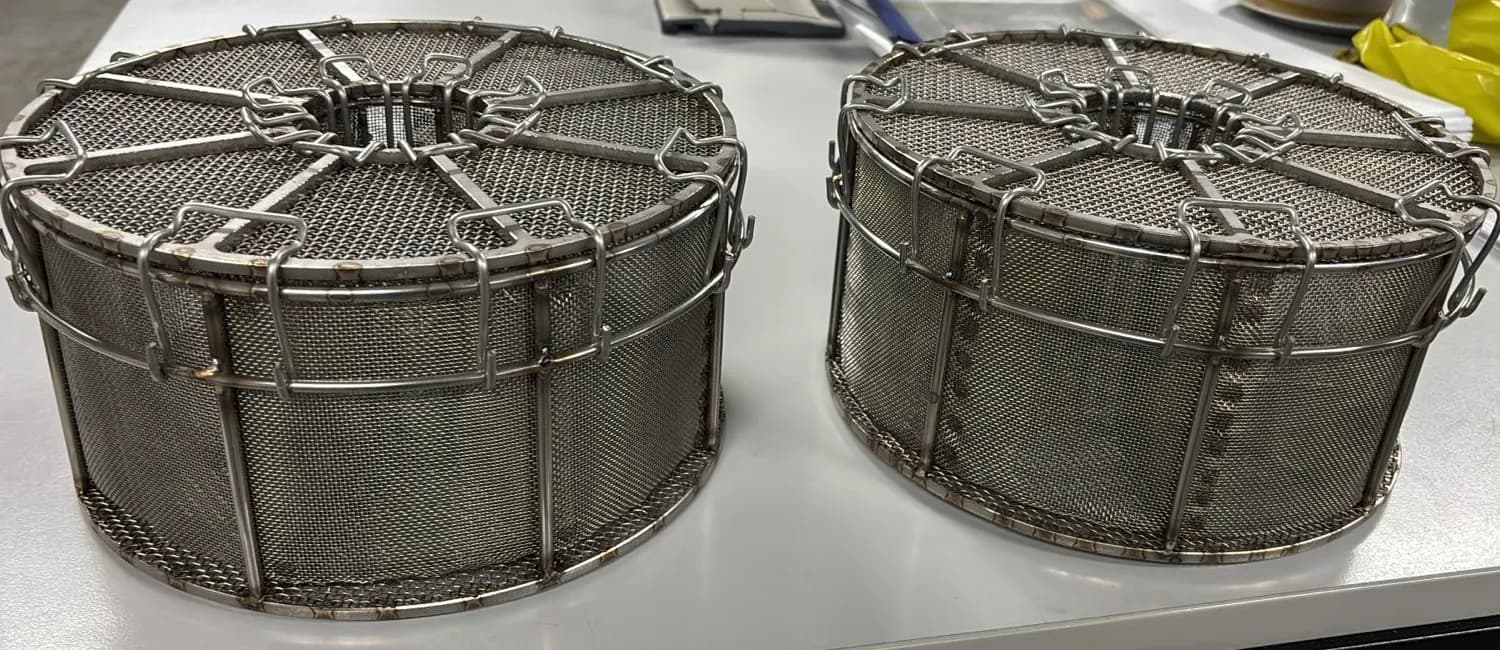
Douna manufactured a series of special canisters for a customer in the petrochemical industry. What initially look like simple baskets are assemblies of fine stainless steel mesh, rings, rods, spokes and fastening clips. The difference in material thickness makes the joints central to the work.
How do you join fine mesh to a rigid frame?
The frame needs sufficient heat to form a sound weld. The mesh consists of wires a fraction of a millimetre thick and can burn through immediately if too much heat is applied. The assembly can also distort: rings lose their round shape and the mesh loses its tension.
Use in a petrochemical installation places demands on the assembly. Loose wires, cracks at joints or corrosion around welds can contaminate the process or cause an unplanned shutdown. Dimensions, joints and finish were therefore considered together.
Our approach
Douna selected the joining process for each part. The frame and the fine mesh each require their own approach to heat input.
TIG welding for the frame, spot welding for the mesh
The frame rings and rods were TIG welded using low current and short welds. The mesh was attached by spot welding. This keeps the heat local to the mesh and reduces the risk of burn-through and distortion. The solution here is the combination of both processes; the parts are not all welded in the same way.
Purpose-made fixtures for repeatable assembly
Douna made dedicated jigs and fixtures for the series. Each canister was assembled in the same position. This supports interchangeability between the assemblies and ensures that each lid fits every basket.
The welding sequence keeps the assembly in shape
The welds were distributed around the assembly. Avoiding a build-up of heat in one place keeps the rings round and the mesh taut. The welding sequence and fixturing are therefore part of preparation, alongside the choice of welding process.
316L stainless steel and the weld zone
The canisters are made from 316L stainless steel. Its low carbon content reduces susceptibility to intergranular corrosion after welding. The process medium and operating conditions remain decisive for material suitability; material selection does not replace controlled welding.
Inspection and handover
The work began with a review of the design. Douna considered weld positions, assembly without distorting the mesh and the lid closure. Engineering and fabrication were coordinated around these points.
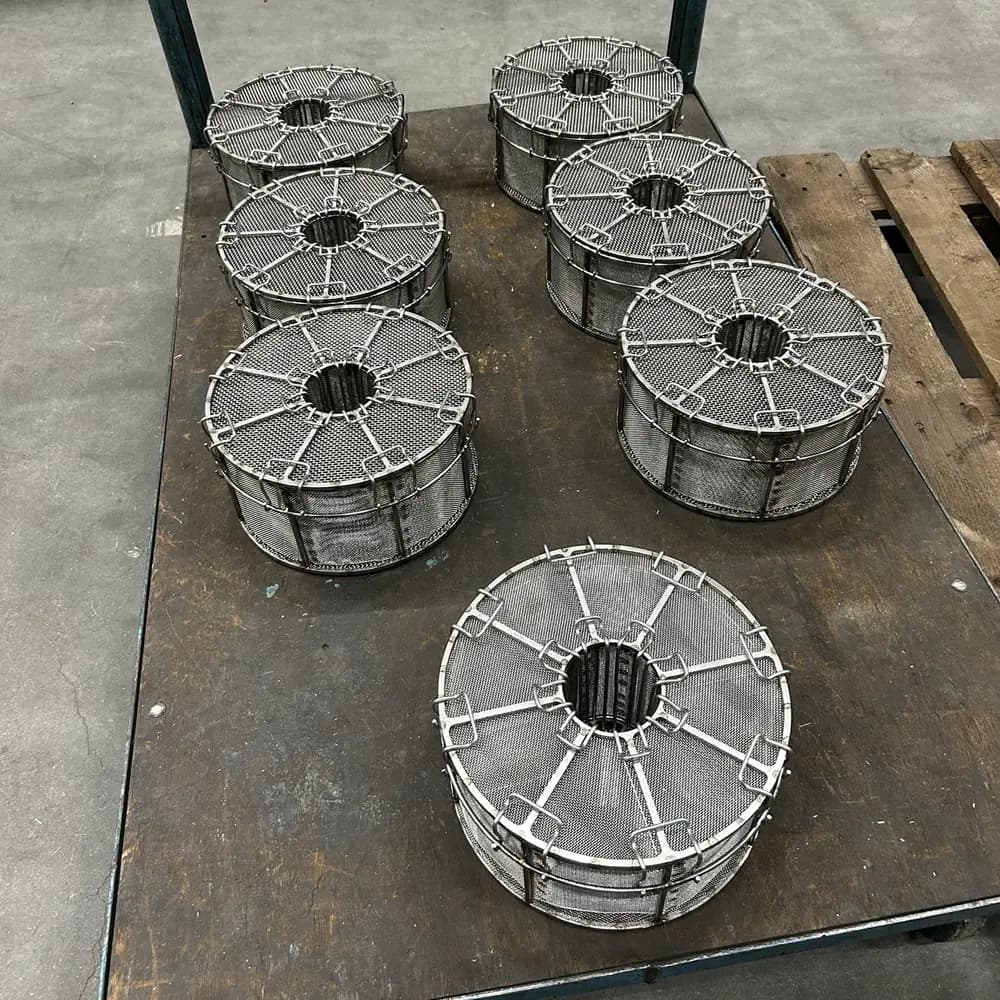
After fabrication, every canister was checked for dimensions, welds and finish. The fit between lid and basket is part of the assembly. Final inspection therefore considers the complete product as well as the joints between individual parts.
Delivered work
A series of 316L stainless steel canisters for the petrochemical industry, with TIG-welded frames and spot-welded mesh. Purpose-made fixtures support repeatable assembly with interchangeable lids and baskets. Douna provided engineering, fabrication and final inspection for this project.