
Technical article
CNC milling: design, workholding and manufacturability
What is CNC milling and what makes a part suitable for it? Explore internal corners, tool access, workholding and the choice between 3 and 5 axes.
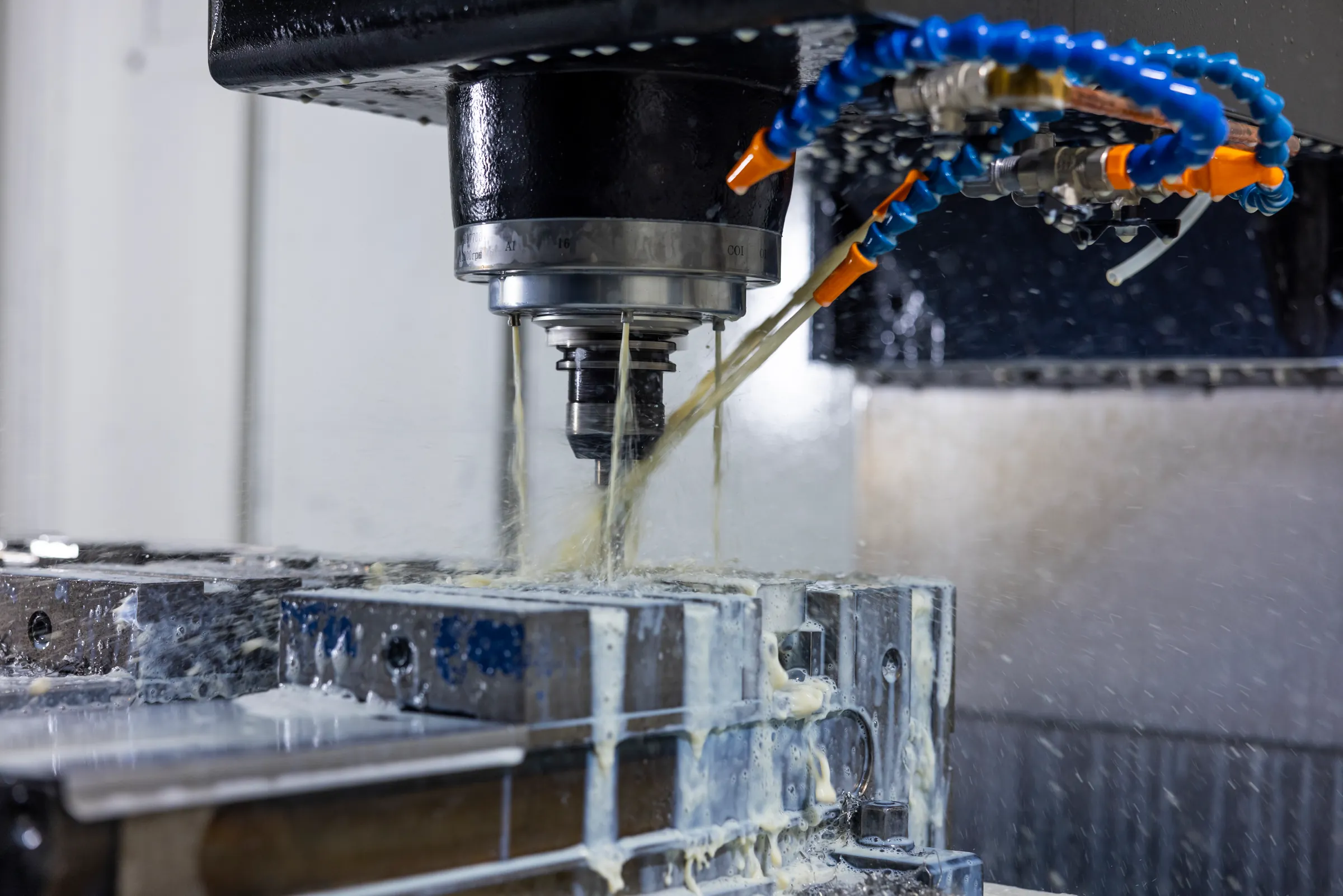
A CAD model that can be milled does not yet define an efficient manufacturing route. Small internal corners, deep pockets and limited clamping space can make a substantial difference. Reviewing these details early helps coordinate design and manufacturing.
Direct answer
What is CNC milling?
In CNC milling, a rotating cutting tool removes material from a clamped workpiece. Computer control directs the toolpath and machine movements. This produces features such as faces, pockets, slots and contours.
Manufacturability depends on more than the programmed shape. The tool, holder and workholding must allow access to every area being machined while maintaining adequate support for the component.
3-axis, 3+2 or simultaneous 5-axis milling?
In 3-axis milling, the linear axes move in three directions. A workpiece requiring operations on several sides may need additional setups. In 3+2 machining, the workpiece or tool is first positioned at an angle and milling then takes place from that position.
In simultaneous 5-axis milling, the rotary axes can also move during cutting. This can suit certain spatial forms or approach angles. More axes do not independently guarantee quality; the geometry and complete machining strategy determine what is needed.
Why do internal corners need attention?
A rotating milling tool has a diameter. An internal pocket corner therefore retains a radius during ordinary contour milling. A sharp corner in the model may require a design change or an additional process.
A very small internal radius restricts tool selection. Cutting load also changes as the tool enters a corner. Discuss whether a larger radius or local relief preserves the assembly function. A functional fit must not be changed without approval.
Deep pockets need room for the tool and holder
A feature can be visible in CAD yet difficult to reach on the machine. The shank and toolholder need space as well as the cutting edge. A deep pocket with a narrow opening can therefore become a significant issue.
Also review thin walls and free-standing details. Preparation must determine how material can be removed without taking away support too early. There is no universal minimum wall thickness: material, height, shape and final function belong in the same assessment.
Workholding and datums connect the operations
When a workpiece is turned over or moved, the relationships between features must be maintained. Determine which faces and holes act as datums and how the part is repositioned. A mounting face may be more important than the outer contour of the raw material.
Clamping surfaces belong in the plan too. If a part is finished on every side, it must be clear how it remains held during the final operation. Fewer setups can help, but one poorly accessible setup is not an objective in itself.
Tolerances and surface requirements follow the application
Specify accurate requirements for features that determine function. Describe their required relative positions and relevant surface requirements as well as individual dimensions. State which features require an inspection report.
Also define the condition in which the component is accepted. Coating or heat treatment after milling may require machining and inspection stages to be coordinated again. Machine resolution or axis count does not replace these product agreements.
What should you provide for assessment?
Provide a model and accompanying drawing at the same revision, together with material, quantities and required final condition. Mark critical internal corners, deep details and functional interfaces. State whether the requirement is a prototype, one-off component or repeat order.
A focused manufacturability discussion identifies which details can be milled directly and which need a design decision or additional operation first. The enquiry then covers both the required result and the conditions needed to achieve it.